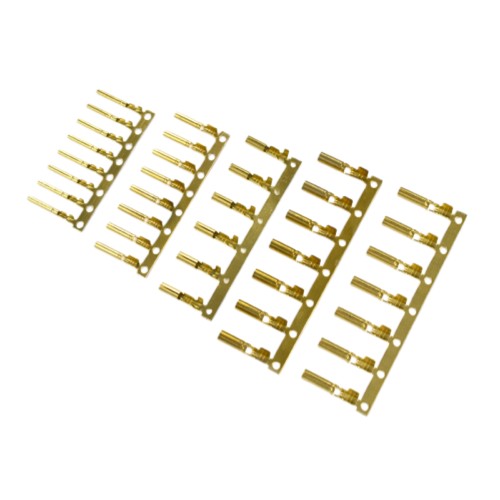
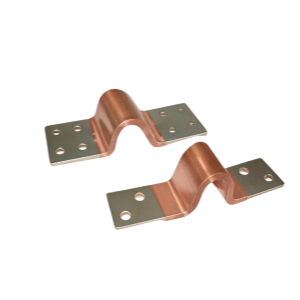
Copper Terminal Stampings / Progressive Die Stamping Electrical Contact
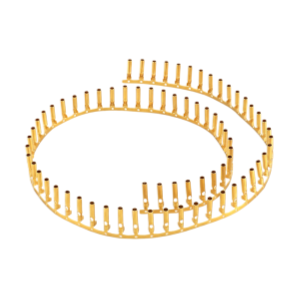
The product shown is a continuous strip of stamped copper terminals, typically made from brass or phosphor bronze. The process involves taking a flat coil of metal and performing a series of sequential operations in a single press stroke to produce finished, plated parts.
These terminals are widely used in Automotive Industrial Control Consumer Electronics Telecommunications — anywhere reliable electrical connection and high-volume production are required.
Copper Terminals Manufacturing Capability
| Parameter | Specification |
|---|---|
| Applicable Materials | C11000 Copper, C26000 Brass, C5191 Phosphor Bronze, C2680 Brass |
| Sheet Thickness Range | 0.2–1.5 mm (typical); 0.1–3.0 mm (custom) |
| Dimensional Tolerance | ±0.05 mm (typical); ±0.02 mm (precision) |
| Process Types | Progressive die (primary); compound die; single-station die (+ crimping, forming, coining) |
| Die Steel | SKD11, DC53, Tungsten carbide (YG20 / YC20C) |
| Die Life | ≥500,000 strokes (progressive); ≥200,000 strokes (single-station) |
| Stamping Speed | 200–1,000 SPM (progressive); 30–80 SPM (single-station) |
| Press Tonnage Range | 25T–250T |
| Single-Station Die T1 Lead Time | 2 weeks |
| Progressive Die T1 Lead Time | 4–6 weeks |
| Surface Finish | Ra 0.4–3.2 µm (as stamped); post-plating: Gold / Tin / Nickel |
| Plating Options | Gold (0.05–3.0 µm), Tin (1–10 µm), Nickel (1–5 µm) |
| Secondary Operations | Deburring, tumbling, selective plating, reeling |
| Quality Standards | ISO 9001, IATF 16949 (automotive), RoHS / REACH compliant |
The Process for Stamping Copper Terminals
1. Material Selection & Preparation
2. The Stamping Process (Inside the Progressive Die)
The die has multiple stations. With each press stroke, the strip advances one station (pitch), and a specific operation is performed.
3. Post-Stamping Operations
4. Quality Control (In-Process)
Why Progressive Die?
This method is chosen for high-volume production. It allows for:
Typical Application Scenarios
Why they are suitable: Copper alloy ensures conductivity and elasticity; gold plating offers low contact resistance and corrosion resistance; crimp barrels enable secure, automated wire termination.
Our Process
Why Choose Us for Stamping Copper Terminals?
1. High-Conductivity Copper Materials
Our copper terminals are manufactured using high-quality copper materials such as C1100 oxygen-free copper, C2680 brass, and phosphor bronze. These materials offer excellent electrical conductivity, good formability, and strong resistance to oxidation, ensuring stable current transmission and long-term reliability.
2. Precision Progressive Die Stamping
We produce copper terminals through precision progressive die stamping, which allows high repeatability and tight dimensional control.
3. Strict Quality Control & Custom Manufacturing
We are an ISO-certified company with a strict quality control system. Every copper terminal is inspected for dimensions, surface quality, burrs, and forming accuracy to meet customer specifications.
4. One-Stop Copper Terminal Stamping Solutions
From mold design, progressive die manufacturing, material selection, stamping production, surface treatment, to final inspection, we provide one-stop stamping solutions. Our copper terminals combine high conductivity, stable performance, competitive pricing, and reliable quality.
We look forward to putting our stamping expertise to work for your copper terminal projects.
Start Your Quote Here
CATEGORIES
LATEST NEWS
CONTACT US
- Mobile: +8615000908770
- Tel: +86-21-51662821
- WhatsApp: 8615000908770
- Email: contact@yxplasticmolding.com
- Address: Room 323, Building B, Hongchun Business Park, No. 980 Qinghewan Road, Qingpu District, Shanghai