
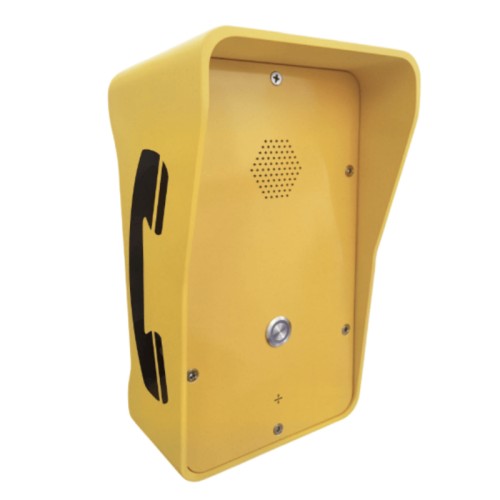
Emergency Call Box Manufacturing & Assembly
Here is how we ensure top-grade quality from metal fabrication to final packaging:
★ Product Specification
1 Metal Parts Fabrication
CHALLENGES- Assembly Gaps: If the front panel, back cover, and side brackets are not cut and bent to tight tolerances, gaps will appear when riveted together, compromising the enclosure's structural integrity and weather resistance.
- Bend Angle Deviation: Inaccurate bending of side panels causes misalignment during assembly, leading to difficulty in riveting and an uneven finish.
- Burrs & Sharp Edges: Laser-cut edges can have burrs that prevent tight fit-up and pose a safety risk during handling.
- The enclosure is manufactured by a sheet metal fabrication process. We use cold-rolled steel and laser-cut the front panel, back cover, side brackets, and other components according to the drawings.
- To reduce assembly gaps, all parts are produced with a tight tolerance of ±0.1 mm.
- We use a CNC bending machine to form the side panels, which ensures perfect accuracy on bend angles and radii.
- All laser-cut edges are deburred before bending to ensure safe handling and tight fit-up.
2 Kitting
CHALLENGES- Part Mix-Ups: Left and right side brackets look similar, and different screw lengths or rivet types are easy to confuse.
- Missing Components: A single missing screw or speaker grille can halt the entire assembly line.
- All components, including sheet metal parts, screws, and the speaker grille, are kitted according to the Bill of Materials (BOM).
- Every part is labeled to ensure no components are missing or mismatched before assembly begins.
- We use color-coded labels and one bin per complete kit, so the operator grabs the bin and moves on — no picking parts one by one.
3 Incoming Quality Control (IQC)
CHALLENGES- Inconsistent Bent Angles: If the bend angle is off, the enclosure won't square up during riveting, causing gaps and misalignment.
- Surface Defects: Scratches, rust, or dents on sheet metal parts will show through the powder coating and cause customer returns.
- Non-Compliant Materials: Using the wrong steel grade or uncertified fasteners can compromise structural integrity and weather resistance.
- Before assembly, all components will be inspected based on ISO 9001 standards. We check dimensions (especially bent angles and location), surface quality, material certifications, and the quality and quantity of rivets and fasteners.
- Any parts that fail inspection are quarantined and returned to the supplier with an NCR (Non-Conformance Report).
4 Riveting & Assembly
CHALLENGES- Loose Connections: If rivets are not set properly, the front panel, back cover, and side brackets will not be tightly connected, leading to rattling, water ingress, and structural failure.
- Speaker Grille Misalignment: The speaker grille must be perfectly aligned with the perforated holes on the front panel, or sound quality will be affected and the unit will look unprofessional.
- Handset Integration: The handset must fit securely on its cradle and the cord must not interfere with the enclosure assembly.
- Once parts pass inspection, we rivet the front panel, back cover, and side brackets together, ensuring they are tightly connected.
- The speaker grille is then carefully installed, making sure it is aligned correctly and fastened.
- We use custom assembly fixtures to hold the enclosure square during riveting, ensuring consistent alignment and tight joints.
- The handset cradle and cord are installed and function-checked before the unit moves to coating.
5 Powder Coating
CHALLENGES- Poor Coverage in Blind Spots: Electrostatic powder struggles to reach the inside corners of the enclosure, the backside of the speaker grille, and around rivet heads, leading to bare spots and corrosion.
- Coating Adhesion: Inadequate pre-treatment (shot blasting) can cause the coating to peel, especially in outdoor weather conditions.
- Color Consistency: The bright yellow color must be uniform across the entire enclosure, including hard-to-reach areas.
- Once the assembly is completed, we do shot blasting and powder coating.
- The bright yellow color of the powder coat not only makes the box highly visible but also helps it be weather-resistant.
- We optimize hanger design to ensure proper grounding and adjust spray gun angles to reach blind spots.
- We strictly control shot blasting roughness (Sa 2.5 grade) and apply a phosphate pre-treatment before coating to enhance adhesion.
- We use high-temperature curing to ensure coating hardness meets stone-chip and weather-resistance standards.
6 Quality Control
CHALLENGES- Hidden Defects: Internal rivet quality, weld integrity (if applicable), and coating adhesion cannot be detected by visual inspection alone.
- Dimensional Deviation: If the enclosure is not square, it won't mount properly on the pole or wall, leading to installation problems.
- Weather Resistance Failure: A unit that passes visual inspection may still leak or rust after prolonged outdoor exposure.
- We enforce strict quality standards throughout production, carrying out Incoming Inspections, First-Article Inspections, Random Sampling, and In-Process Checks.
- First Article Inspection (FAI): Full dimensional and functional report on the first production batch.
- In-Process Checks: Rivet tightness, speaker grille alignment, and handset function checked every 10–20 pieces.
- 100% Visual Inspection: Coating uniformity, color match, and cosmetic appearance checked on every unit.
- Fitment Check: Mounting hole alignment verified with Go/No-Go gauge and master jig.
- Salt Spray Testing: Samples from each batch are tested to verify corrosion resistance.
7 Packaging
CHALLENGES- Transport Damage: Emergency call boxes are heavy and have a painted finish that is easily scratched or chipped. Poor packaging can lead to damage during global shipping.
- Lost Hardware: Screws, rivets, and mounting brackets can easily go missing in transit.
- Each emergency call box is protected using custom-molded foam inserts to protect it from being destroyed during shipping.
- Small hardware is placed in individually sealed PE bags, secured to a fixed position inside the box to prevent shifting.
- We use 5-layer corrugated boxes with added corner protectors to ensure stacking strength.
Quality Control Specifications
1 Incoming Quality Control (IQC)
- Dimension Inspection: We measure the sheet metal parts with a calibrated vernier, protractor, and height gauge — bent angles and hole locations get a close look. Hold it to ±0.1 mm.
- Surface Quality Check: Look it over and run a hand across it — sharp edges, burrs, rust, scratches, dents. If your finger catches on anything, it's not passing.
- Material Certification Review: Before we accept a batch, we pull the Mill Test Certificate and check it against the spec — chemical composition and mechanical properties have to match. No MTC, no intake.
- Hardware Inspection: We check that the threads are clean, plating intact, and grade marking legible. Short count or bad grade, the lot comes back.
2 In-Process Checks
- Rivet Tightness Check: Verify that rivets are fully set and the front panel, back cover, and side brackets are tightly connected. No movement or rattling allowed.
- Speaker Grille Alignment: Confirm the grille is correctly aligned with the perforated holes and securely fastened.
- Handset Function Check: Test handset cradle fit, cord connectivity, and audio function before coating.
- Bend Angle Verification: Check the angle and radius against the drawing. Keep it within ±1°, or it goes back for rework.
3 First Article Inspection (FAI)
- Full Dimensional Report: We measure every critical dimension on the CMM or with calibrated hand tools: overall length, width, height, bend angles, mounting hole positions, and bracket locations.
- Assembly Report: We write down three things: are the rivets pulled tight, is the speaker grille sitting straight, and does the handset actually work? No blanks — every line gets a result.
- Material Verification: We pull the MTC and match the grade to what's on the certificate. Grade doesn't read right, the batch doesn't come in.
- Surface Finish Check: Gauge the coating thickness and hold the part up against the color standard. If the coat is too thin or off-color, it doesn't pass.
- Fitment Trial: Mount the call box onto a master jig or actual pole/wall frame to confirm fitment.
4 Random Sampling (AQL-Based)
- AQL Standard: Use ISO 2859-1 / GB/T 2828.1 (or equivalent) with AQL levels 1.0 – 2.5 depending on criticality.
- Sampling Plan: Determine sample size (AQL 1.5), for example: Lot 500 pcs → Sample 50.
- Inspection Items: Dimensional check, rivet tightness, coating thickness, color match, mounting hole position.
- Recording: Log results in the QC sampling record sheet.
5 100% Inspection
- Coating Uniformity: Every part gets a visual check for bare spots, orange peel, runs, sags, or color mismatch.
- Coating Thickness: Verify film thickness is within 60–120 μm using a magnetic or eddy current gauge.
- Rivet & Assembly Check: 100% visual check for loose rivets, misaligned grille, or handset issues.
- Mounting Hole Fitment: Insert Go/No-Go gauge pins into all mounting holes to verify diameter and position.
6 Functional & Environmental Testing
- Handset Audio Test: Verify speaker and microphone function on every unit.
- Salt Spray Test: Samples from each batch are tested to verify corrosion resistance (≥ 48 – 96 hours).
- Water Resistance Test: (If applicable) Verify IP rating by subjecting the unit to water spray or submersion.
- Drop Test: A 1-meter drop test is performed on samples to check structural integrity.
Summary Table — Quality Control Specifications
| QC Stage | Inspection Item | Method | Frequency | Acceptance Criteria |
|---|---|---|---|---|
| IQC | Dimension, bend angle, surface, material cert | Calipers, protractors, MTC review | 100% of lots | Within ±0.1 mm, no burrs, cert matches |
| In-Process | Rivet tightness, grille alignment, handset function | Visual, function test | Every 10–20 pcs | No loose rivets, grille aligned, handset works |
| FAI | Full dimensional & assembly report | CMM, fitment jig | Once per NPI | All dims within tolerance, fitment OK |
| Random Sampling | Dimensional, rivet, coating, color | AQL 1.0–2.5 | Per lot | Defects ≤ Ac |
| 100% Inspection | Coating, rivet, hole fitment | Visual, Go/No-Go | 100% | Zero critical defects |
| Functional Testing | Handset audio, salt spray, drop test | Audio test, salt spray, drop rig | 1–2 per batch / 5–10% | Audio clear, no rust, no structural failure |
Why Choose Us?
1. ISO 9001 Certified
From incoming material inspection to final packaging, we control every process to ISO 9001 standards. We also provide material certifications (MTC), salt spray test reports, and compliance documents to meet your market requirements.
2. High Precision Sheet Metal Fabrication
We hold all sheet metal parts to ±0.1 mm. We use CNC bending machines to ensure precise bend angles of ±1°, and we build custom fixtures to keep the enclosure square while we're riveting—eliminating gaps and ensuring a professional finish.
3. Rust-Resistant Powder Coating
Shot blasting + phosphating pre-treatment ensures maximum coating adhesion. The bright yellow powder coat is highly visible and tested to 48–96 hours of salt spray for outdoor weather resistance.
4. Good Packaging for Global Shipping
We protect products with custom-molded foam inserts and a 5-layer corrugated carton—designed to survive international transit and protect the painted finish, speaker grille, and handset. We individually bag small hardware and secure it to prevent loss.
5. Low MOQ & Fast Lead Time
From prototype to mass production, we support low MOQs for new products and scale up to high-volume runs. Our in-house tooling and fixture capability means faster lead times and better cost control.
Start Your Quote Here
CATEGORIES
LATEST NEWS
CONTACT US
- Mobile: +8615000908770
- Tel: +86-21-51662821
- WhatsApp: 8615000908770
- Email: contact@yx-molding.com
- Address: Room 323, Building B, Hongchun Business Park, No. 980 Qinghewan Road, Qingpu District, Shanghai