
Handheld Pool Vacuum Cleaner — Manufacturing, Assembly & Quality Control
Here is how we ensure top-grade quality from mold design to final products:
Product Specification
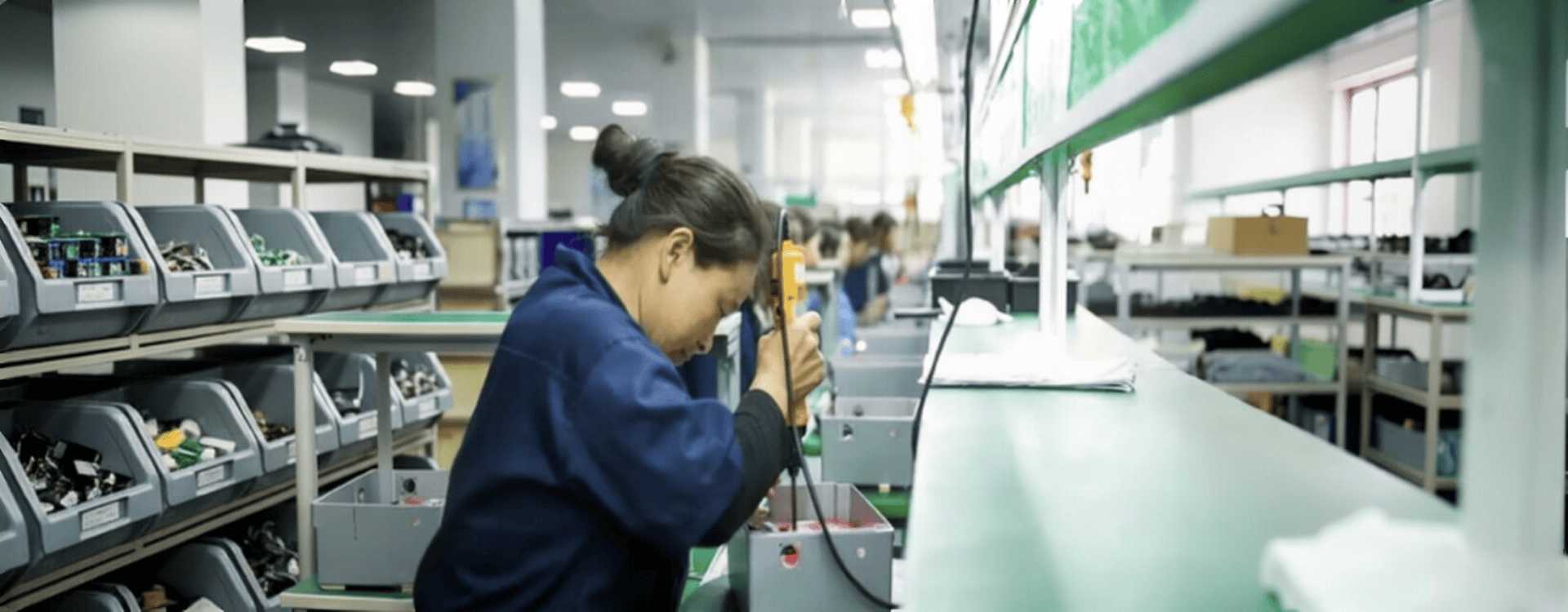
Assembly Process
1 Mold Design & Engineering
CHALLENGES
- Tight Tolerance Fit: The main housing and extension pole must fit perfectly. If the tolerance is too loose, the pole wobbles; if too tight, it won't assemble.
- Material Degradation: Pool vacuum cleaners are constantly exposed to water, chlorine, and UV light. Inferior plastic will fade, crack, or become brittle.
- Mold Flow Issues: Poor mold design causes warping, sink marks, or weak weld lines in the housing, leading to water leaks.
OUR METHOD
- Strict Tolerances: We hold ±0.1 mm on the housing-to-pole interface. We machine the pole's locking mechanism to high precision to prevent sliding during use.
- Material Selection: We use food-grade, UV-resistant ABS/PC plastic to prevent color fading and maintain high strength.
- Mold Flow Analysis: We run Mold Flow Analysis to check every sector — including decorative appearance — before cutting steel. This catches warping, weld lines, and filling issues at the design stage.
2 Parts Kitting
CHALLENGES
- Part Mix-Ups: Left and right housing halves look similar, and different pole lengths or filter cartridge variants are easy to confuse.
- Missing Components: A single missing O-ring or screw can halt the entire assembly line.
OUR METHOD
- All components are sourced and collected according to the Bill of Materials (BOM).
- We color-code labels and use one bin per complete kit, so the operator grabs the bin and moves on — no picking parts one by one.
- Every bin is labeled and verified against the BOM before it reaches the line.
3 Incoming Quality Control (IQC)
CHALLENGES
- Inconsistent Plastic Dimensions: If the housing is out of spec, it won't seal properly, causing water leaks.
- Unsafe or Non-Compliant Materials: Food-grade and UL compliance are mandatory for pool products.
- Rusty or Defective Metal Parts: Stainless steel poles or screws with surface rust hurt both assembly and final product life.
OUR METHOD
- Before assembly, all incoming components are inspected based on ISO 9001 standards — dimension check & decorative appearance check, food-grade safety material certifications, and UL compliance.
- We also check metal parts for rust, burrs, and thread integrity before they enter the line.
4 Assembly
CHALLENGES
- Motor & Battery Water Intrusion: If the motor or battery compartment is not perfectly sealed, water will enter and destroy the electronics.
- Pole Slipping: The extension pole must lock firmly. A weak click-lock mechanism will slide during use, making the vacuum unusable.
- Filter Housing Leaks: If the transparent filter cartridge is not tightened evenly, water bypasses the filter and leaks from the housing.
OUR METHOD
5 Quality Control & Testing
CHALLENGES
- Hidden Water Leaks: A vacuum may pass a quick visual check but fail after 10 minutes of submersion.
- Structural Weakness: A drop on a hard pool deck can crack the housing or break the pole lock.
- Wear & Tear: The telescopic pole locks and trigger switches must survive thousands of cycles.
- Cosmetic Defects: Scratches, color mismatch, or packaging damage can cause customer returns.
OUR METHOD
- First Article Inspection (FAI): Make dimension and function checks on the first production batch.
- IPX7 Waterproof Test: 100% of pool cleaners do IPX7 submersion testing to guarantee water resistance.
- Drop Test: A 1-meter drop test is performed to check structural integrity.
- Life Cycle Test: Telescopic pole locks and trigger switches are tested for over 5,000 cycles.
- AQL Level II Inspection: Check function, cosmetic defects (scratches, color mismatch), and packaging integrity every batch.
6 Packaging
CHALLENGES
- Transport Damage: The vacuum has a painted finish and a transparent filter housing that are easily scratched. The extension pole can bend or dent.
- Lost Hardware: Screws, O-rings, and small accessories can easily go missing in transit.
OUR METHOD
- The product is placed in a custom-molded foam part, then a 5-layer corrugated cardboard carton is used to protect it from being damaged during shipping.
- Small hardware is placed in individually sealed PE bags, secured to a fixed position inside the box to prevent shifting.
- Corner protectors are added to ensure stacking strength.
Quality Control Specifications
1 Incoming Quality Control (IQC)
- Dimension Inspection: Measure housing, pole, and filter cartridge dimensions using calibrated vernier calipers, micrometers, and gauges.
- Decorative Appearance Check: Visual inspection for scratches, flow marks, color mismatch, or sink marks on plastic parts.
- Material Certification Review: Verify food-grade safety certifications and UL compliance for all plastic and electrical components.
- Hardware Inspection: Screws, O-rings, and metal poles are inspected for stripped or damaged threads, surface rust, and plating wear.
2 In-Process Checks
- Ultrasonic Weld Inspection: Check weld line uniformity and seal integrity on the main housing. Verify no gaps or weak points.
- Torque Verification: Confirm torque-controlled screws on the filter housing are within specification (e.g., 0.8–1.2 N·m).
- Pole Lock Function Check: Test the "click-lock" mechanism for proper engagement, elasticity, and holding strength.
- Pre-Assembly Fit-Up Check: Build the unit all the way up, then dunk it for an IPX7 pre-test — checking that everything lines up right and the seal actually holds water out.
3 First Article Inspection (FAI)
- Full Dimensional Report: We measure every critical dimension on the CMM or with calibrated hand tools: housing OD, pole length, filter cartridge fit, overall length, width, height, and locking mechanism positions.
- Functional Report: Log the motor run, suction pull, battery hookup and seal check — if any one of them is off, it doesn't ship.
- Material Verification: Confirm material grade against MTC and food-grade certificates.
- Surface Finish Check: We measure the coating thickness with a gauge and eyeball the surface for runs, orange peel, or bare spots. If it looks rough or reads thin, it gets pulled.
- Fitment Trial: Build the unit all the way up, then dunk it for a full IPX7 pre-test. We're checking that every part lines up right, and the seal actually holds water.
4 Random Sampling (AQL-Based)
- AQL Standard: Use ISO 2859-1 / GB/T 2828.1 (or equivalent) with AQL levels 1.0 – 2.5 depending on criticality.
- Sampling Plan: Determine sample size (AQL 1.5), for example: Lot 500 pcs → Sample 50.
- Inspection Items: Dimensional check, weld visual, coating thickness, color match, pole lock function, and packaging integrity.
- Recording: Log results in the QC sampling record sheet.
5 100% Inspection
- IPX7 Waterproof Test: 100% of pool cleaners undergo full submersion testing to guarantee water resistance.
- Coating & Cosmetic Uniformity: Every part gets a visual check for bare spots, orange peel, runs, sags, or color mismatch.
- Pole Lock & Trigger Function: 100% function check on telescopic pole locks and trigger switches.
- Packaging Integrity: Verify foam inserts, PE bags, and carton condition before sealing.
6 Functional & Reliability Testing
- Drop Test: A 1-meter drop test is performed to check structural integrity.
- Life Cycle Test: Telescopic pole locks and trigger switches are tested for over 5,000 cycles.
- Suction Performance Test: Every batch gets a suction pull test — we need to see at least 15 kPa, or the batch doesn't move forward.
- Battery & Motor Test: Confirm charging, runtime, and motor function before final packaging.
Summary Table — Quality Control
| QC Stage | Inspection Item | Method | Frequency | Acceptance Criteria |
|---|---|---|---|---|
| IQC | Dimension, appearance, material cert | Calipers, MTC review | 100% of lots | Within tolerance, no defects, cert matches |
| In-Process | Ultrasonic weld, torque, pole lock | Visual, torque gauge | Every 10–20 pcs | No weld gaps, torque within spec, lock functions |
| FAI | Full dimensional & functional report | CMM, IPX7 pre-test, fitment jig | Once per NPI | All dims within tolerance, IPX7 passes |
| Random Sampling | Dimensional, weld, coating, function | AQL 1.0–2.5 | Per lot | Defects ≤ Ac |
| 100% Inspection | IPX7, cosmetic, function, packaging | Submersion, visual, function test | 100% | Zero critical defects |
| Functional Testing | Drop, life cycle, suction, battery | Drop rig, cycle tester, gauge | 1–2 per batch / 5–10% | No structural failure, ≥5,000 cycles, suction ≥15 kPa |
Why Choose Us?
ISO 9001 Certified
From incoming material inspection to final packaging, we control every process to ISO 9001 standards. We also provide food-grade material certifications, UL compliance, and salt spray test reports to meet your market requirements.
Ultrasonic Welding to Avoid Leaks
The main housing is sealed with ultrasonic welding — no glue, no screws. The weld holds tight enough to pass full IPX7 submersion, so the motor and battery stay dry.
100% IPX7 Waterproof Testing
After assembly, we perform a full IPX7 submersion test on every single pool vacuum. We don't just spot-check a few from each batch—we test each one, so leaks don't slip through, and your brand stays clean.
Good Packaging for Global Shipping
We protect products with custom-molded foam and 5-layer corrugated carton—a system designed to survive international transit and protect the painted finish, transparent filter housing, and extension pole. We individually bag small hardware and secure it to prevent loss.
Precision Mold Design & Engineering
The housing-to-pole fit is held to ±0.1 mm — tight enough that the seal seats cleanly every time. Before we cut any steel, we run a Mold Flow Analysis to spot warping and weld lines early, so the mold is right the first time. The parts are molded in food-grade, UV-resistant ABS/PC, which holds up against chlorine and sunlight without fading or going brittle.
Low MOQ & Fast Lead Time
From prototype to mass production, we support low MOQs for new products. Our in-house tooling and fixture capability means faster lead times and better cost control.



Start Your Quote Here
CATEGORIES
LATEST NEWS
CONTACT US
- Mobile: +8615000908770
- Tel: +86-21-51662821
- WhatsApp: 8615000908770
- Email: contact@yxplasticmolding.com
- Address: Room 323, Building B, Hongchun Business Park, No. 980 Qinghewan Road, Qingpu District, Shanghai