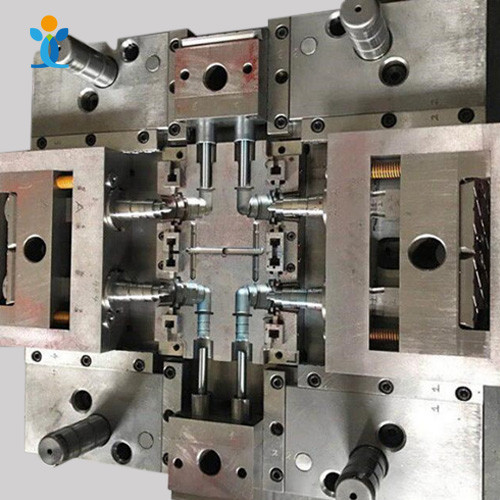
Multi-Cavity slide fixture edge-gate injection mold designed specifically to produce plastic pipe fittings — such as elbows, bends, or angled connectors. The mold uses side sliders (cams) and angled ejector pins to form the internal hollow structure and the fitting’s curved geometry.
Built on an LKM (Standard) or Custom Heavy-Duty mold base with 718H, S136 or NAK80 hardened wear-resistant steel, it is engineered for engineering plastics (PVC, PPR, PE, ABS, PA) and rated for 500,000+ shots, delivering long mold life under the high pressures and mechanical stress of repeated slider movement.
Precision side sliders (cams), a custom angled ejection system, high-strength guide pins and hardened wear plates combine to form the elbow undercut, eject the curved part without deformation and keep uniform wall thickness — ensuring seamless, hollow, pressure-rated fittings every cycle.
Technical Specifications
Core Characteristics
Complex Slider Mechanism
The mold features precision-engineered side sliders (cams) that move laterally to form the undercut geometry of the elbow, allowing the production of a seamless, hollow part.
Angled Ejection System
A specialized angled ejector-pin system follows the part’s curvature and pushes the curved part off the core evenly, without deformation.
High-Precision Core Alignment
The central core and cavity blocks must align perfectly to ensure uniform wall thickness in the hollow, pressure-rated fitting.
Robust Construction
Built with hardened steel and heavy-duty guide pins to withstand the high injection pressures and the mechanical stress of the slider movement.
Processing Difficulties & Countermeasures
1. Slider (Side Core) Design & Movement
DifficultyThe elbow shape has an undercut that a simple straight-pull mold cannot form. The side sliders must move laterally to form the curved geometry and then retract before ejection. Any misalignment or wear in the slider mechanism can cause flashing or damage to the part.
CountermeasureWe design the sliders with hardened steel wear plates and precision guide rails to ensure smooth, accurate movement. We use mechanical cams or hydraulic cylinders (for larger molds) to drive the sliders, and Mold Flow Analysis (MFA) to ensure the sliders do not interfere with filling.
2. Angled Ejection of Curved Parts
DifficultyThe elbow fitting is curved, and standard straight ejector pins can cause the part to bind or deform during ejection. The angled ejector pins must be designed to follow the part’s curvature.
CountermeasureWe design a custom angled ejection system that matches the geometry of the fitting. The ejector pins are positioned at the optimal angle to push the part off the core evenly, and we use sleeve ejectors or air-assisted ejection where necessary to prevent deformation.
3. Core Alignment & Uniform Wall Thickness
DifficultyThe internal core (which forms the hollow inside of the elbow) must align perfectly with the cavity to ensure uniform wall thickness. Any misalignment creates thin spots or flashing, compromising the fitting’s pressure rating.
CountermeasureWe use high-strength guide pins and bushings for precise alignment, machine the core and cavity to tight tolerances using high-speed CNC and EDM, and use Mold Flow Analysis to simulate filling and predict potential wall-thickness variations.
4. Weld Line Strength
DifficultyWhen plastic flows around the core to form the hollow elbow, it creates a weld line (where two flow fronts meet). This weld line can be a weak point, especially in pressure-rated fittings.
CountermeasureWe optimize the gate location and injection speed to move the weld line to a non-critical area, use hot runner systems to maintain melt temperature and improve weld line strength, and in some cases apply sequential valve gating to control the flow front and eliminate weld lines.
5. Slider Wear & Maintenance
DifficultyThe sliders move back and forth with every cycle, causing wear on the guide rails and wear plates. Over time, this wear can cause flashing and dimensional inconsistencies.
CountermeasureWe use hardened tool steel (e.g., S136 or H13) for the sliders and wear plates, apply surface treatments like nitriding or chrome plating to improve wear resistance, and provide a detailed maintenance manual with recommended inspection and lubrication of the slider mechanism.
6. Demolding & Part Sticking
DifficultyThe curved, hollow shape of the elbow can create a vacuum between the part and the core, making it difficult to eject. The part may also stick to the sliders if they do not retract fully.
CountermeasureWe use air poppet valves to break the vacuum between the part and the core, ensure the sliders retract fully before ejection, and carefully calibrate the ejection stroke to prevent part damage.
Applicable Industries
Our Workflow
A transparent, step-by-step process from design to delivery.
Stage 1: R&D Support & DFM Analysis
We support customer R&D for complex pipe fittings. We create or improve 3D files (UG, SolidWorks, ProE, AutoCAD, etc.). Crucially, we provide a Mold Flow Analysis (MFA) report to optimize fill balance, weld-line location, and slider design.
Stage 2: Mold Process & Slider Integration
Mold design (DFM report) → check/approve → approved → make mold → integrate slider mechanism → produce sample → sample confirmed → check final mold quality, ready to export.
We specifically validate the slider movement and the ejection system during this stage.
Stage 3: Sample Modification & Dimensional Optimization
If the first sample doesn’t meet the customer’s requirements (e.g., flashing or wall-thickness variations), we can modify the mold. We fine-tune the slider fit and injection parameters to meet your exact requirements.
Stage 4: Sample Delivery
Produce the customer’s requested quantity (typically 500-1000 shots for validation), with free shipping.
Stage 5: Final Delivery
Deliver goods by sea or air; we can accommodate special requirements (like custom crating for the heavy mold) based on customer needs.
Why Choose Us?
Partner with a trusted leader in precision injection molding.
20+ Years of Experience
We have successfully produced more than 1,500 new injection molds and parts since 2006. We have deep expertise in slider molds and complex pipe fittings for the plumbing and automotive industries.
ISO9001 Certificated
Strict quality control system, providing ROHS/CE certification for your peace of mind. We ensure every mold base, slider, and steel insert meets rigorous dimensional and wear-resistance standards.
One-Stop Service
We provide more value-added operations to simplify your supply chain from design to delivery. From Mold Flow Analysis to slider mechanism design, we handle the technical complexity so you don’t have to.