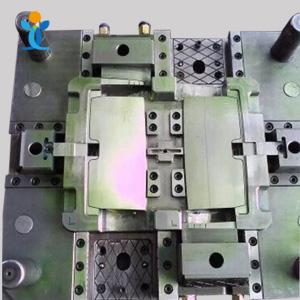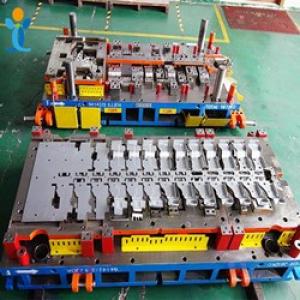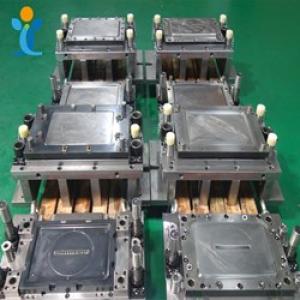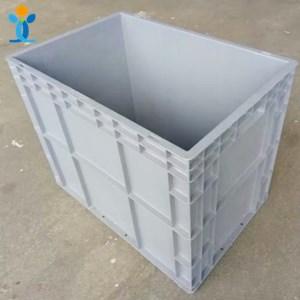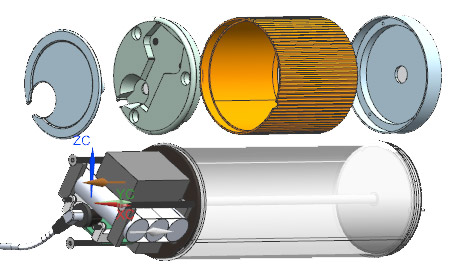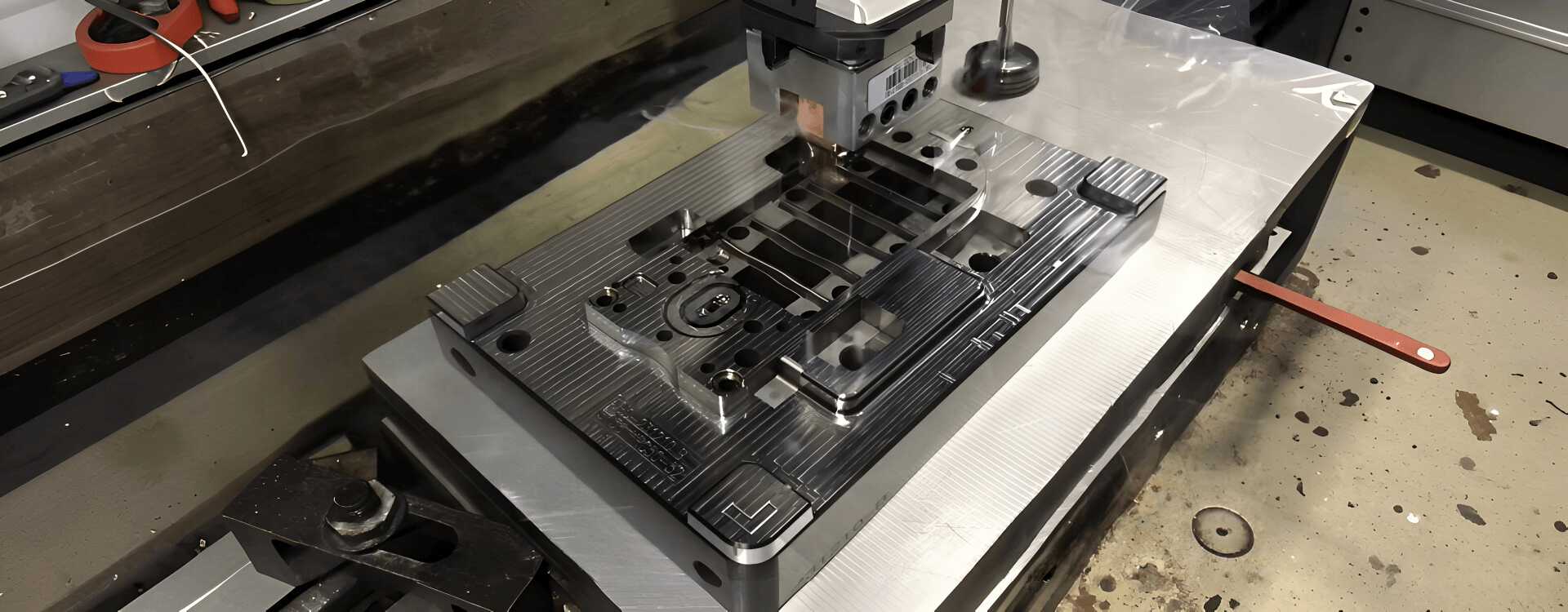
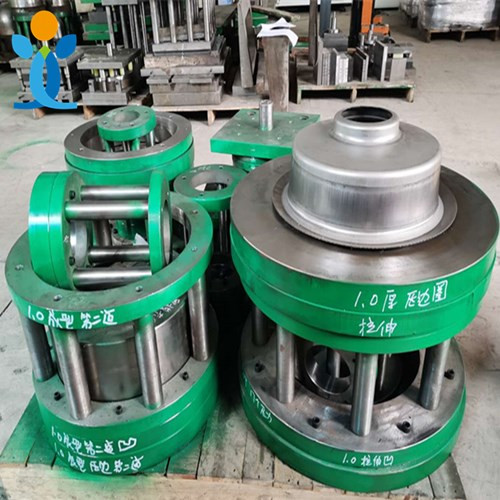
This single-station deep drawing die produces pot-shaped components — such as sensor housings, motor cases, bushing shells, or filter cups. Each die performs one specific drawing operation, and the part is transferred between dies for successive draws until the final pot depth is reached.
Built with DC53 / SKD11 / Cr12MoV tool steel for high wear resistance and toughness, the die is rated for approximately 500,000 – 1,000,000 strokes. It runs on a 1000 kN press with manual transfer between dies, deep drawing DC04, SPCC, SPHC, SUS304, SS316, aluminum or copper at 1.0 mm thickness (0.5–6.0 mm acceptable) and tolerances down to ±0.2 mm for diameter and height.
Technical Specifications
Key Features of This Mold (Single-Station Deep Drawing)
1. Single-Station Deep Drawing Design
Each die performs one specific drawing operation (first draw, second draw, third draw, sizing). Operators manually transfer the part to the next die for the next stage — ideal for large pot-shaped parts that require multiple draws.
2. Heavy-Duty Guide System
Four large guide pillars with helical springs maintain perfect alignment between the upper and lower die halves during deep drawing — essential for pot-shaped parts with tight tolerances (±0.2 mm) to ensure uniform wall thickness and prevent earing or wrinkling.
3. Complex Inserts & Drawing Punches
The die contains drawing punches, dies, and blank holders. The modular design makes maintenance easier — if one drawing section wears out, you replace only that insert, minimizing downtime and maintenance cost.
4. High-Quality Base and Structure
The die is mounted on a thick, solid steel base plate can resisting vibration of a mechanical press — ensuring long-term stability even when deep drawing SS304 / SS316 or thicker materials.
5.High-Quality Blank Holder Design
High-quality blank holders can control material flow and prevent wrinkling — holding the blank flat during drawing and stripping the finished part off the punches after forming.
6. Angled Cam Bending Mechanism
A cam-driven side bending unit allows complex bends that standard vertical press motion cannot achieve, forming the part's side walls, flanges, or reinforcement ribs — common features in automotive pot-shaped parts.
Manufacturing Process (Single-Station Deep Drawing)
Single-station deep drawing integrates one operation per die. The process flow for a pot-shaped part usually follows this sequence.
1. Blanking
A circular or shaped blank is cut from the metal strip or sheet.
2. First Draw
The blank is drawn into a shallow cup shape using a drawing punch and die.
3. Second Draw
The cup is drawn deeper into a pot shape — the diameter is reduced and the height is increased.
4. Third Draw
Further drawing to achieve the final depth and diameter.
5. Reshaping / Coining
A reshaping die corrects the shape, ensures dimensional accuracy and reduces springback.
6. Trimming
Any excess material or uneven edges (earing) are trimmed off to define the final outline.
7. Flanging / Piercing
Additional operations to create flanges or holes if required.
Challenges & Solutions
1. Dimensional Accuracy and Consistency
ChallengeMaintaining the precise shape, diameter and height of the pot-shaped part is difficult — parts often require ±0.2 mm tolerance and must be interchangeable.
SolutionUse high-precision guide pillars and bushings to keep the dies perfectly aligned, with regular inspection of drawing clearances. Use CMM inspection for first-article and in-process verification.
2. Tool Wear and Life
ChallengeRepeated high-impact deep drawing wears the drawing edges and forming surfaces, especially with thicker steel or stainless steel (SS304 / SS316).
SolutionUse DC53 or SKD11 tool steel with proper deep-drawing lubrication (up to +30% die life). Apply TiCN / TiAlN coatings to punches and polish the drawing dies to a mirror finish to reduce friction.
3. Wrinkling and Tearing
ChallengeThe material is prone to wrinkling (compressive stress) or tearing (excessive tensile stress) — particularly critical for structural parts.
SolutionUse an appropriate blank holder force (BHF), optimize the drawing radius and clearance at design using AutoForm simulation, apply proper lubrication and consider drawing beads to control material flow.
4. Springback and Material Thickness Variance
ChallengeThe metal springs back after drawing, affecting final dimensions, and different batches cause inconsistencies — critical for structural parts.
SolutionCompensate for springback at design phase using AutoForm simulation, add a sizing station to correct the shape after forming, and run regular incoming-material quality checks.
5. Cam Bending Accuracy
ChallengeThe side cam bending mechanism is prone to wear and alignment issues, affecting the angle and position of side flanges — flange angle tolerance is critical for fit and function.
SolutionUse high-strength cam drivers and wear plates, inspect cam contact surfaces, and adjust cam stroke for consistent bend angles. Hardened inserts (HRC 58–62) provide long-term durability.
6. Surface Finish and Lubrication
ChallengeDeep drawing generates significant friction and heat, which can cause galling, scratching or seizure on the part surface.
SolutionUse high-viscosity deep drawing lubricants, polish die surfaces to a mirror finish and apply TiCN / TiAlN coatings to drawing punches and dies; regularly lubricate and clean the die.
Single-Station Deep Drawing Dies Advantage
High Precision
Ideal for tight-tolerance metal parts held within ±0.2 mm.
Cost-Effective for Low Volume
Lower tooling cost than progressive dies for complex deep-drawn parts.
Flexibility
Easy to adjust or modify individual drawing stations independently.
Automation
Can be equipped with robotic transfer for continuous production.
Our Process (Deep Drawing Parts)
Inquiry → DFM Analysis → Die Design → Die Manufacturing → Sample Approval → Small Batch Order → Mass Production → Shipping.
1. Inquiry
Customer provides part drawings, material specs (e.g., SPCC, SPHC, SUS304), tolerance requirements and annual volume for the part.
2. DFM Analysis (Design for Manufacturing)
Our engineers analyze blank size, material utilization, drawing sequence, potential forming defects — plus requirements such as crashworthiness, fatigue resistance and dimensional stability before make the mold design, then send optimization feedback.
3. Die Design
3D CAD design of the deep drawing die: drawing punch and die block, guide pillar and spring system, blank holder and ejection mechanism, cam bending mechanism for complex side flanges, and AutoForm simulation to predict springback, thinning and wrinkling.
4. Die Manufacturing
Material procurement (DC53, SKD11, etc.), CNC machining, wire EDM and grinding, heat treatment for punches and inserts, polishing of drawing dies to mirror finish, assembly and fitting, and spotting and tryout to tolerance standards.
5. Sample Approval
Trial run on the press. First articles are measured and inspected using a CMM, and samples are sent for dimensional and functional approval, including PPAP documentation if required.
6. Small Batch Order
After sample approval, a small production batch verifies die stability, consistency and speed — ensuring quality and cycle-time requirements.
7. Mass Production
Full-scale production with manual or robotic transfer, producing thousands of parts per hour. In-process inspection and SPC (Statistical Process Control) maintain quality.
8. Shipping
We pack, label and ship finished parts on schedule, offering custom packaging and traceability labels.
Why Choose Us for Deep Drawing Die Solutions?
Partner with a trusted leader in precision deep drawing die manufacturing for the automotive industry.
20+ Years of Experience
Since 2006 we have produced more than 1,500 dies and stamped parts, including pot-shaped parts, sensor housings and motor cases.
ISO9001 Certified
Strict quality control aligned with ISO9001 standards, providing ROHS / CE certification and PPAP documentation for your peace of mind.
One-Stop Service
Value-added operations simplify your supply chain from design to delivery, including welding, tapping, plating and powder coating.
In-House Die Manufacturing
Complete capability from DFM analysis and die design to machining, assembly and trial runs — all under one roof. No outsourcing delays.
High-Speed Production
Deep drawing dies designed for manual or robotic transfer, producing thousands of precision parts per hour, optimized for high-volume automotive programs.