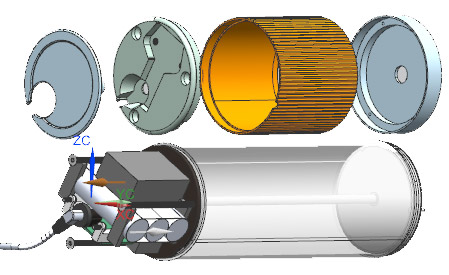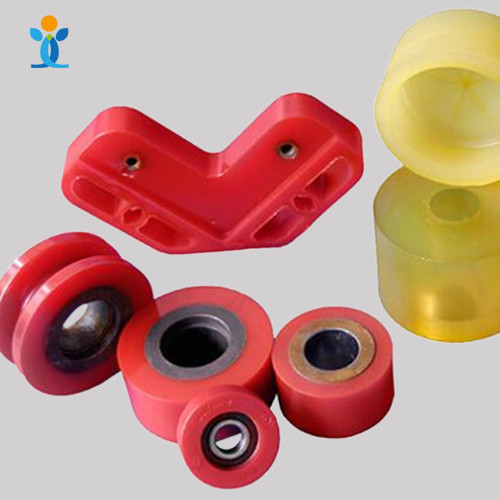
Insert Injection Mold (or Transfer / Compression Mold) for metal-plastic & rubber bonded parts — Designed to produce vibration isolators (V-mounts), suspension bushings and industrial rollers. The mold must hold the metal inserts precisely in place while injecting rubber or polyurethane (PU) to bond permanently to the metal surface.
Built on an LKM (Standard) or Custom Heavy-Duty mold base with P20, 718H or hardened tool steel to resist abrasive rubber compounds, it is engineered for PA, PA+GF, NR, EPDM, NBR or PU and rated for 300,000+ shots, delivering long mold life on demanding bonded parts.
Custom locating pins and nests, tight-tolerance insert pockets, multi-zone temperature control and a mechanically-locking cavity combine to keep inserts centered, prevent flash and create a strong mechanical & chemical bond — ensuring a defect-free, permanently bonded part every cycle.
Technical Specifications
Core Characteristics
Precise Insert Positioning
The mold features custom-designed locating pins and cavities to hold the metal inserts securely during high-pressure injection, preventing displacement.
Strong Bonding Surface
The mold design ensures the PA flows evenly around the metal insert, creating a strong mechanical and chemical bond (often aided by pre-applied adhesives).
Complex Geometry Capability
Capable of producing intricate shapes like the red V-mount, with multiple mounting holes and varying thicknesses.
Durable Construction
Built with hardened steel to withstand the abrasive nature of rubber compounds and the high pressures of injection molding.
Processing Difficulties & Countermeasures
1. Precise Insert Loading & Positioning
DifficultyThe metal inserts must be placed perfectly centered and level in the mold. If an insert is misaligned, the PA will flow unevenly, causing a weak bond or a defective part. Manually loading many small inserts is also time-consuming.
CountermeasureWe design custom locating pins and nests in the mold to hold the inserts securely. For high-volume production, we can design automated insert feeding systems or multi-cavity layouts to improve efficiency, plus hardened guide pins for precise mold alignment.
2. Flash & Precision Shut-off
DifficultyPA can easily seep into the parting lines or gaps around the metal inserts, creating flash (excess material) that is difficult to remove. The mold must shut off precisely against the metal insert.
CountermeasureWe machine the insert pockets with tight tolerances (often within 0.01mm) to ensure a tight seal against the metal, use high-quality guide pins and bushings for precise alignment, and optimize the clamping force and injection pressure to minimize flash.
3. Strong Bonding Between Plastic and Metal
DifficultyThe plastic must bond permanently to the metal insert. If the bond fails, the part will delaminate under load. Mold surface and metal insert surface preparation are critical.
CountermeasureWe design the cavity to mechanically lock the rubber onto the metal (e.g., grooves or undercuts), work with the customer to ensure inserts are properly degreased and coated with a bonding agent before loading, and precisely control mold temperature to activate the bonding process.
4. Uniform Curing & Temperature Control
DifficultyPA and other plastic materials require precise temperature control to cure properly. Uneven heating can cause under-cured (sticky) or over-cured (brittle) parts. The thick sections of the V-mount and the thin sections of the bushing require different curing times.
CountermeasureWe design multi-zone temperature control systems with cartridge heaters or oil circulation channels placed close to the cavities, use thermocouples to monitor and adjust temperature in real time, and run Mold Flow Analysis (MFA) to simulate the curing process and optimize cycle time.
5. Mold Wear & Maintenance
DifficultyPA is abrasive and can wear down the mold over time, especially at the gates and insert pockets. This leads to flash and dimensional inconsistencies.
CountermeasureWe use hardened tool steel (e.g., S136 or H13) for the cavity and core, apply surface treatments like chrome plating or nitriding to improve wear resistance, and provide a detailed maintenance manual recommending regular inspection of the gate and insert areas.
Applicable Industries
Our Workflow
A transparent, step-by-step process from design to delivery.
Stage 1: R&D Support & DFM Analysis
We support customer R&D for metal-rubber bonded parts. We create or improve 3D files (UG, SolidWorks, ProE, AutoCAD, etc.). Crucially, we provide a Mold Flow Analysis (MFA) report to optimize the insert positioning, gate location, and curing process.
Stage 2: Mold Process & Insert Integration
Mold design (DFM report) → check/approve → approved → make mold → integrate insert loading system → produce sample → sample confirmed → check final mold quality, ready to export.
We validate insert positioning accuracy and bonding strength during this stage.
Stage 3: Sample Modification & Bonding Optimization
If the first sample doesn't meet the customer's requirements (e.g., flash or weak bonding), we can modify the mold. We fine-tune the insert pockets and injection parameters to meet your exact requirements.
Stage 4: Sample Delivery
Produce the customer's requested quantity (typically 500-1000 shots for validation), with free shipping.
Stage 5: Final Delivery
Deliver goods by sea or air; we can accommodate special requirements (like custom crating for the heavy mold) based on customer needs.
Why Choose Us?
Partner with a trusted leader in precision injection molding.
20+ Years of Experience
We have successfully produced more than 1,500 new injection molds and parts since 2006. We have deep expertise in insert molding and PA / PU / other plastic and rubber bonding for the automotive and industrial sectors.
ISO9001 Certificated
Strict quality control system, providing ROHS/CE certification for your peace of mind. We ensure every mold base and steel insert meets rigorous dimensional and wear-resistance standards.
One-Stop Service
We provide more value-added operations to simplify your supply chain from design to delivery. From Mold Flow Analysis to insert preparation and bonding agent application, we handle the technical complexity so you don't have to.