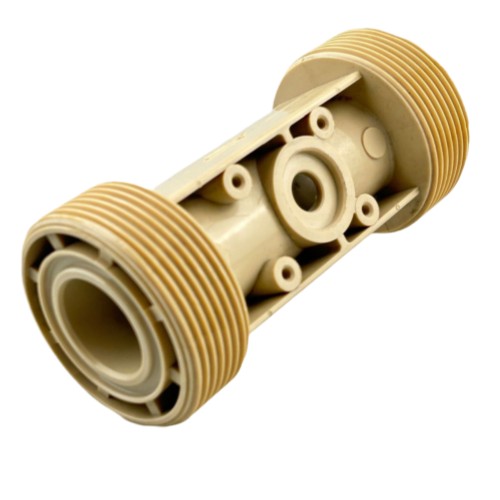
Specifications
| Parameter | Specification / Description |
|---|---|
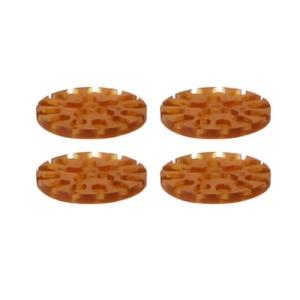
| Material | PEEK |
| Color | Natural / Black / Customizable |
| Mold Cavity | 1 (Single cavity) |
| Tolerance | ±0.02mm (for critical dimensions, e.g., threads & bore) |
| Continuous Use Temp | Up to 250°C (Short-term up to 300°C) |
| Shrinkage Rate | 0.4–0.7% (Unfilled PEEK) |
| Surface Finish | SPI-A1 Mirror Finish (Internal bore) / SPI-B1 or Texture (External ribs & threads) |
| MOQ | 100 – 1,000 pcs |
| Lead Time |
Samples: 20–25 days Mass Production: 30–45 days (PEEK requires high mold temps & slow cooling) |
| Processing | Injection Molding (Requires high mold temp 180–200°C) |
| Application | Chemical fluid handling / Medical device component / Aerospace connector / Analytical instrument housing |
| Packing | Anti-static bag + EPE foam + Export carton |
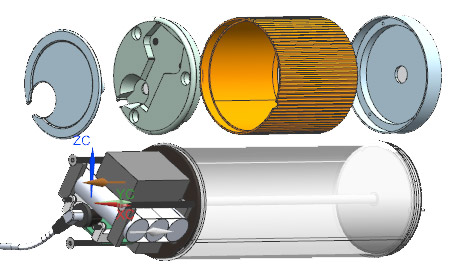
This part is very complex. Here's a breakdown to show us how we design the mold:
Mold Design Breakdown
Injection Process Parameters
Melt temperature should be set between 360°C and 400°C, with mold temperature maintained at 170°C–200°C to ensure proper crystallization and dimensional stability. Injection pressure generally ranges from 100–140 MPa, while holding pressure is about 60–80% of the injection pressure to minimize shrinkage. Injection speed should be medium to high to avoid premature freezing, and back pressure is kept low at 0.3–1.0 MPa. Cooling time usually ranges from 30 seconds depending on wall thickness, and screw speed is set at 50 rpm. Due to PEEK's high processing temperature and viscosity, we use a hot runner system to control the temperature, and the mold was designed with adequate venting and heating capacity. Post-mold annealing at 200°C–250°C for 2–4 hours is typically applied to relieve internal stress and optimize mechanical properties.
Material Advantages
PEEK offers exceptional continuous service temperature resistance up to 250°C, making it suitable for the most demanding thermal environments. It provides outstanding chemical resistance against acids, bases, and organic solvents, ensuring long-term reliability in aggressive media. PEEK is inherently self-extinguishing and achieves UL94 V-0 flame retardancy without additives. Its high strength-to-weight ratio delivers excellent mechanical performance while significantly reducing component weight. As a premium engineering plastic, PEEK is an ideal metal replacement in applications requiring lightweight, corrosion-resistant, high-strength, and high-temperature performance.
Typical Application Scenarios
- Semiconductor wafer carriers / wafer box components
- Medical devices (sterilizable structural parts)
- Aerospace high-temperature insulation components
- Automotive turbocharger / sealing parts
- Petrochemical corrosion-resistant valve components, bearing cages
- Electronic connectors (metal replacement)
Our Workflow
A transparent, step-by-step process from design to delivery.
We support customer R&D. Create the files or improve the design if needed (UG, SolidWorks, ProE, AutoCAD etc.)
Mold design (DFM report) → check/approve → approved → make mold → produce sample → sample confirmed → check final mold quality ready to export.
If the first sample does not satisfy the customer, we can modify the mold to meet customers' requirements.
Produce the customer's requested quantity, free shipping.
Deliver goods by sea or by air; special requirements can be accommodated based on customer demands.
Why Choose Yixing Technology?
Partner with a trusted leader in precision injection molding.
- 20+ Years Experience
- More than 1500 new injection molds and parts have been successfully produced since 2006.
- ISO9001 Certificated
- Strict quality control system, providing ROHS/CE certification for your peace of mind.
- One Stop Service
- More value-added operations provided to simplify your supply chain from design to delivery.
Start Your Quote Here
CATEGORIES
LATEST NEWS
CONTACT US
- Mobile: +8615000908770
- Tel: +86-21-51662821
- WhatsApp: 8615000908770
- Email: contact@yxplasticmolding.com
- Address: Room 323, Building B, Hongchun Business Park, No. 980 Qinghewan Road, Qingpu District, Shanghai