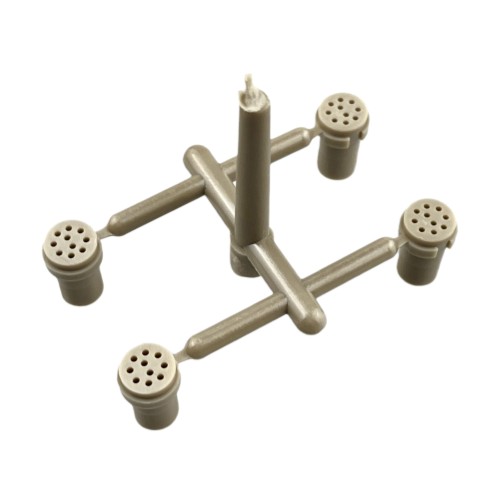
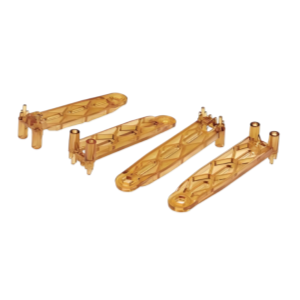
4 Cavities Injection Molding PEEK Part
This is a 4-cavity PEEK molding part. We need to balance fill speed across all branches while also addressing venting issues around the porous areas. Here is a breakdown of how we design the mold:
1Gate Location Design
We use a center pin gate (submarine gate), and we place it at the top or bottom center of the central cylindrical body.
Why it works: PEEK melt flows radially from the center outward, giving us the shortest and most symmetrical flow paths. This helps keep filling pressure consistent at the ends of all four branches, which reduces warping caused by flow imbalance.
Why it works: PEEK melt flows radially from the center outward, giving us the shortest and most symmetrical flow paths. This helps keep filling pressure consistent at the ends of all four branches, which reduces warping caused by flow imbalance.
2Special Handling for the "Porous Ends"
Those four ends with all the small holes are basically difficult for injection molding – they're mainly areas for trapped gas that causes burns or short fills.
Venting comes first: The gate design has to work hand-in-hand with venting. Ideally, the melt should push from the root of the holes toward the openings, not be trapped inside those tiny holes.
Balanced runners: The connecting bars (runners) between the center and the four ends need to have consistent thickness. If they're too thin, the melt will cool down and won't be able to fill those thin wall sections around the holes. We recommend making the runner diameter at least 0.8 to 1 times the thickest wall section of the part.
3Gate Size and Type Optimization
We select Fan gate or Tab gate, where the melt enters the cylindrical ends, go with a fan-shaped transition. PEEK has high viscosity; if the injection system has a sudden change in cross-section, it will cause jetting marks. A fan design needs to let the melt spread out smoothly and prevent it from blasting straight into the core pins.
Size control: PEEK solidifies really fast, so gate thickness is usually about 50–70% of the part wall thickness. For precision parts like this, we don't want the gate too small – that creates too much shear heat and can degrade the material (turning it black). But we also don't want it too big; the cooling time drags out, and internal stress increases.
Start Your Quote Here
CATEGORIES
LATEST NEWS
CONTACT US
- Mobile: +8615000908770
- Tel: +86-21-51662821
- WhatsApp: 8615000908770
- Email: contact@yxplasticmolding.com
- Address: Room 323, Building B, Hongchun Business Park, No. 980 Qinghewan Road, Qingpu District, Shanghai